


Every year Japan’s Ministry of Health, Labour and Welfare sends people into pharmacies and onto websites to buy medicine while pretending to be ordinary customers. They are not. They are surveyors, and they record whether the rules that govern how medicine is sold were actually followed. The FY2025 round was published on 7 August 2026, and it is the closest thing there is to a factual answer to a question cross-border buyers ask constantly: when you buy medicine in Japan, over a counter or through a website, what is supposed to happen — and does it?
What the survey actually is
The method is a mystery-shopper survey: surveyors act as general consumers and attempt an actual purchase. Store visits ran from December 2025 through January 2026, and online purchases from December 2025 through February 2026. The store sample was 1,506 outlets — 807 pharmacies (yakkyoku) and 699 retail drug sellers (tenpo hanbaigyo). The online sample was 257 sellers.

That distinction between the two store types matters and is easy to miss. A yakkyoku is a pharmacy that can dispense against prescriptions and must have a pharmacist. A tenpo hanbaigyo is a retail seller licensed to sell non-prescription medicine, which may operate with a registered seller (tōroku hanbaisha) rather than a pharmacist for the lower risk categories. The survey reports many items broken out by both.
These numbers predate the May 2026 reform
One date relationship decides how the whole survey should be read. Fieldwork ran from December 2025 to February 2026. Japan’s amended Pharmaceuticals and Medical Devices Act — which introduced online medication guidance for guidance-required medicines and tightened the handling of designated abuse-prevention medicines — took effect on 1 May 2026.
So this round measured the system as it stood before those rules changed. It is a baseline, not a report card on the reform. The FY2026 round, whenever it appears, will be the first that can show what the reform actually changed. The reform itself we cover separately, in our note on the 2026 update to Japan’s medicine sales system.
The store results
Among store items, the ones tied to who is standing there scored high. Surveyors could tell staff categories apart from name badges in 92.9% of visits. For designated category medicines (yōshidō iyakuhin), the person giving information was a pharmacist in 96.3% of cases, and the user’s condition was checked in 96.8%. For Class 1 medicines, a pharmacist gave the information in 91.8%, and when a question was asked, an appropriate answer came back 99.5% of the time.
The items that dropped were procedural. Written information provision for Class 1 medicines happened in 76.7% of visits. Confirming that the customer had understood the information happened in 65.4% — the lowest figure in the entire store set. For designated category medicines, written information provision was 81.0%, and checking whether the purchaser was the actual user was 73.6%.
The online results
Online, the pattern inverts. Anything a web form can enforce came back at or near a perfect score: the user’s condition was checked in 100.0% of Class 1 purchases, understanding was confirmed in 100.0%, and the required alert for designated Class 2 medicines registered in 100.0%. Information was provided in 92.5%.
Where online fell away was the human part. For Class 1 medicines, the person who provided the information was a pharmacist in 81.6%. When a consultation was requested, an answer always came — 100.0% — but the person answering was a pharmacist in only 58.8%. For Class 2 and equivalent consultations, the responder was a pharmacist or registered seller in 64.0%.
Store versus online, item by item
| Item | Store | Online |
|---|---|---|
| Class 1: user’s condition checked | 94.8% | 100.0% |
| Class 1: information provided (store: in writing) | 76.7% | 92.5% |
| Class 1: understanding of information confirmed | 65.4% | 100.0% |
| Class 1: information given by a pharmacist | 91.8% | 81.6% |
| Class 1 consultation: responder was a pharmacist | 89.5% | 58.8% |
| Class 2 etc. consultation: responder was qualified | 82.8% | 64.0% |
| Designated Class 2: alert registered | 85.4% | 100.0% |
| Medicines with abuse potential: sales method appropriate | 86.8% | 90.5% |
Note on comparability: the two channels were surveyed with separate item sets, and some wording differs — the store item is “information provided in writing” while the online item is “information provided”. Store items also carry different qualified-person requirements by category (Class 2 store consultations are measured against registered sellers; online Class 2 consultations against pharmacists or registered sellers). Read the table as two profiles side by side, not as a strict like-for-like comparison. Figures are from the MHLW summary document, FY2025 round, published 7 August 2026.
The pattern worth taking away
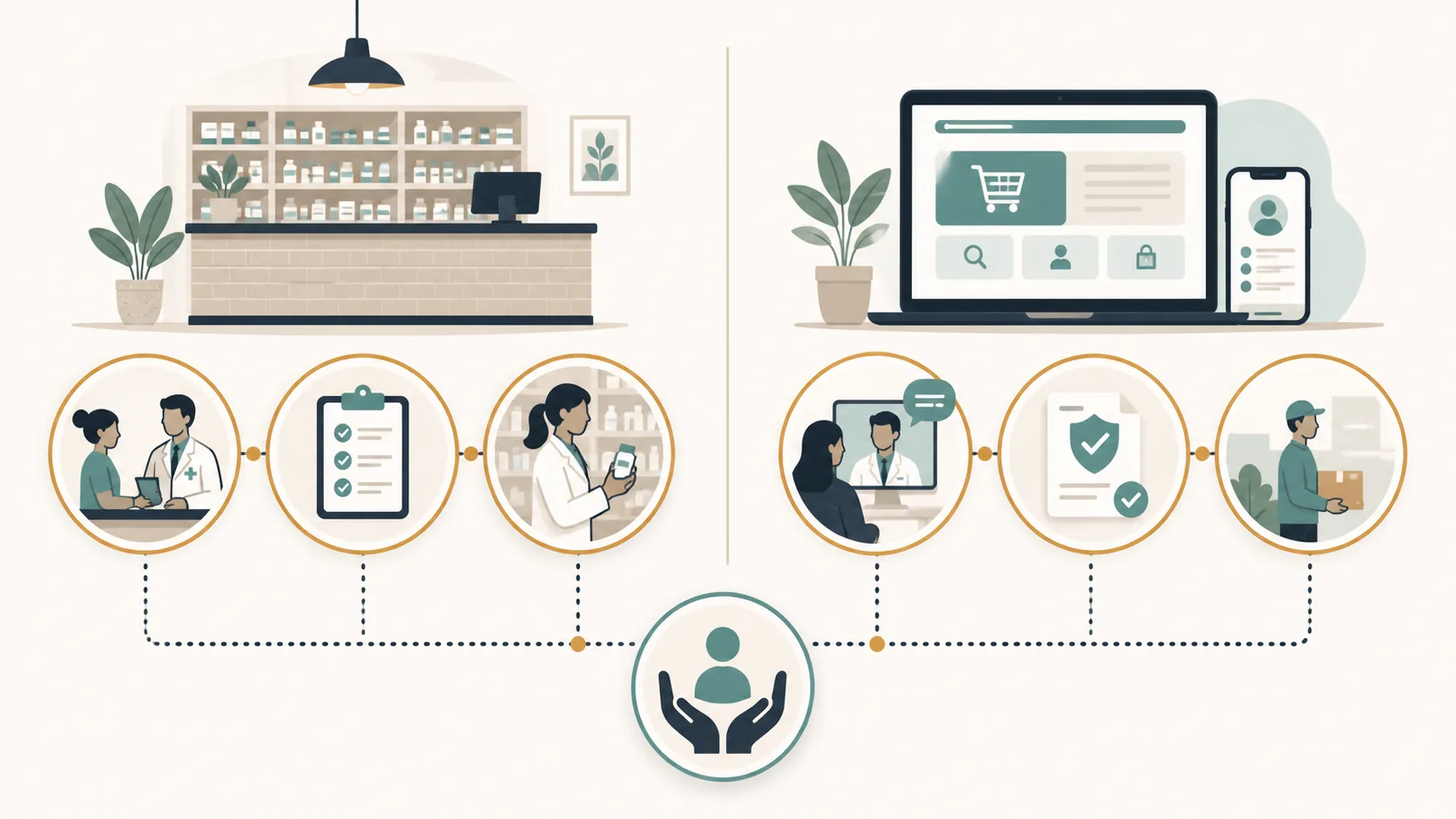
The weak points of the two channels are mirror images. Online selling is close to perfect at every step a system can force — the checkbox, the displayed warning, the confirmation screen — and weakest at the step that requires a qualified human to actually be there. Physical stores are the reverse: the qualified person is present, but the procedural steps around them, especially confirming that the customer understood what was said, are where the numbers fall.

For someone buying medicine in Japan, that translates into something concrete. Buying a Class 1 medicine online, the process will run to completion and every screen you are supposed to see will appear. But if you ask a question, the survey found that a bit under six times in ten was the person answering a pharmacist. In a store the odds reverse: a pharmacist is very likely to be the one answering you, but you may not be handed written information, and you are unlikely to be asked whether you followed it.
What that pharmacist confirmation is supposed to cover, step by step, is set out in our walkthrough of the Class-1 online purchase process. Reading it alongside these figures is the point: one describes what should happen, the other measures how often it does.
Why this survey exists at all
Japan sorts non-prescription medicine into categories carrying different handling requirements — designated category medicines requiring a pharmacist face-to-face, then Class 1, Class 2 (with a designated sub-tier), and Class 3 — and each category attaches its own duties about who may sell, what must be provided, and what must be checked. A rule structure that detailed only means something if it is executed at the counter and on the page. The mystery-shopper survey is the mechanism by which the ministry finds out, and because it runs annually, its year-on-year movement is the actual measure of whether the rules are working.

None of this tells you whether a particular site is legitimate — the survey is anonymised and aggregate. For that question there are published signals you can check yourself, which we set out in the four red lines for judging an online pharmacy. More of this kind of comparison sits in Global Pharmacy Watch.
FAQ
Who conducts this survey and how often?
Japan’s Ministry of Health, Labour and Welfare conducts it annually. The FY2025 round was published on 7 August 2026 and used surveyors acting as general consumers to make real purchases.
How large was the sample?
1,506 physical outlets (807 pharmacies and 699 retail drug sellers) and 257 internet sellers.
Does a pharmacist always answer when you ask a question online?
No. In the FY2025 round, when a consultation was requested for a Class 1 medicine online, an answer was always returned, but the responder was a pharmacist in 58.8% of cases. The equivalent store figure was 89.5%.
Which result was the lowest in the store sample?
Confirming that the customer had understood the information provided for a Class 1 medicine, at 65.4%.
Can I use these figures to judge a specific pharmacy or website?
No. The survey reports aggregate, anonymised results across the sample. It does not identify individual outlets or sellers, and it is not a rating of any particular business.
References
- 厚生労働省「令和7年度医薬品販売制度実態把握調査結果について」(令和8年8月7日公表)https://www.mhlw.go.jp/stf/newpage_75385.html
- 厚生労働省「令和7年度医薬品販売制度実態把握調査結果(概要)」https://www.mhlw.go.jp/content/11121000/001735076.pdf
- 厚生労働省「令和7年度医薬品販売制度実態把握調査結果(報告書)」https://www.mhlw.go.jp/content/11121000/001735077.pdf
出典:厚生労働省ホームページ(https://www.mhlw.go.jp/stf/newpage_75385.html)を加工して作成。
This article is for information only. It is not medical advice, not guidance on using any specific medicine, and not advertising for any prescription medicine. Facts here come from Ministry of Health, Labour and Welfare public materials; Tsubaki Trading holds a Tokyo Metropolitan Governor’s wholesale pharmaceutical distribution licence (No. 5313250689) and works with these regulatory documents directly. See our editorial policy.