


The Japanese phrase senshin iryō is usually rendered in English as “advanced medical care”, and that translation quietly does damage. It reads like a quality rating — the most advanced treatment a hospital can offer. It is not that. It is a defined position inside Japan’s public health insurance system, and what it actually tells you is something narrower and more useful: that a treatment is being evaluated for whether insurance should cover it, and that until that question is settled, you pay for that part yourself.
The legal definition, and what it does not say
The Ministry of Health, Labour and Welfare defines it as care “using advanced medical technology designated by the Minister of Health, Labour and Welfare, and other care, for which evaluation is necessary from the standpoint of the efficient provision of appropriate medical care, as to whether or not it should become subject to insurance benefits.”
Read that clause again for what it leaves out. It says nothing about the treatment being better than the insured alternative. The operative word is evaluation. A technology enters this category to be assessed, and the assessment can end either way: it can move into standard insurance coverage, or it can be removed. As of August 2026 there are 73 such technologies.

Where it sits in the billing system
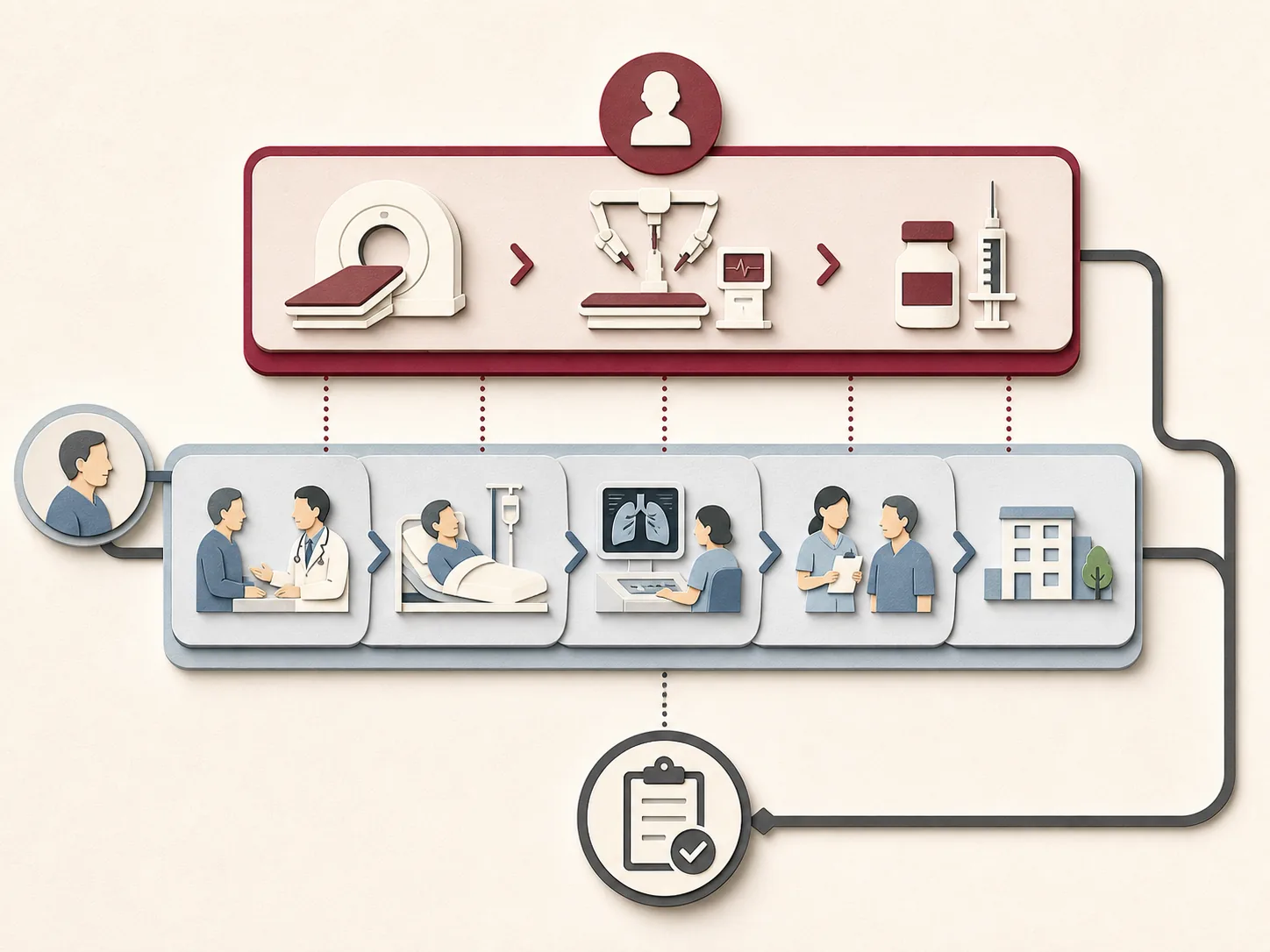
Japan’s public insurance normally does not allow mixing covered and uncovered treatment in a single episode of care. The exception is the hoken-gai heiyō ryōyōhi framework, which permits that mix in specified cases. It separates into care “evaluated for the purpose of insurance adoption” — this is where advanced medical care sits — and care “not premised on insurance adoption”, which covers things like private rooms, appointment fees, and out-of-hours consultations. A third mechanism, kanja mōshide ryōyō, has operated since fiscal 2016 and starts from a patient’s own request.
The cost split follows from that structure. In the ministry’s own words: the portions “common to general medical care (the basic portion), such as basic hospitalisation fees, are covered by insurance, and the advanced medical care portion is the patient’s own burden.” Two layers, one bill. We are not quoting figures here — the amount for the uncovered layer is set per technology and per institution, so any single number would mislead.
Type A and Type B
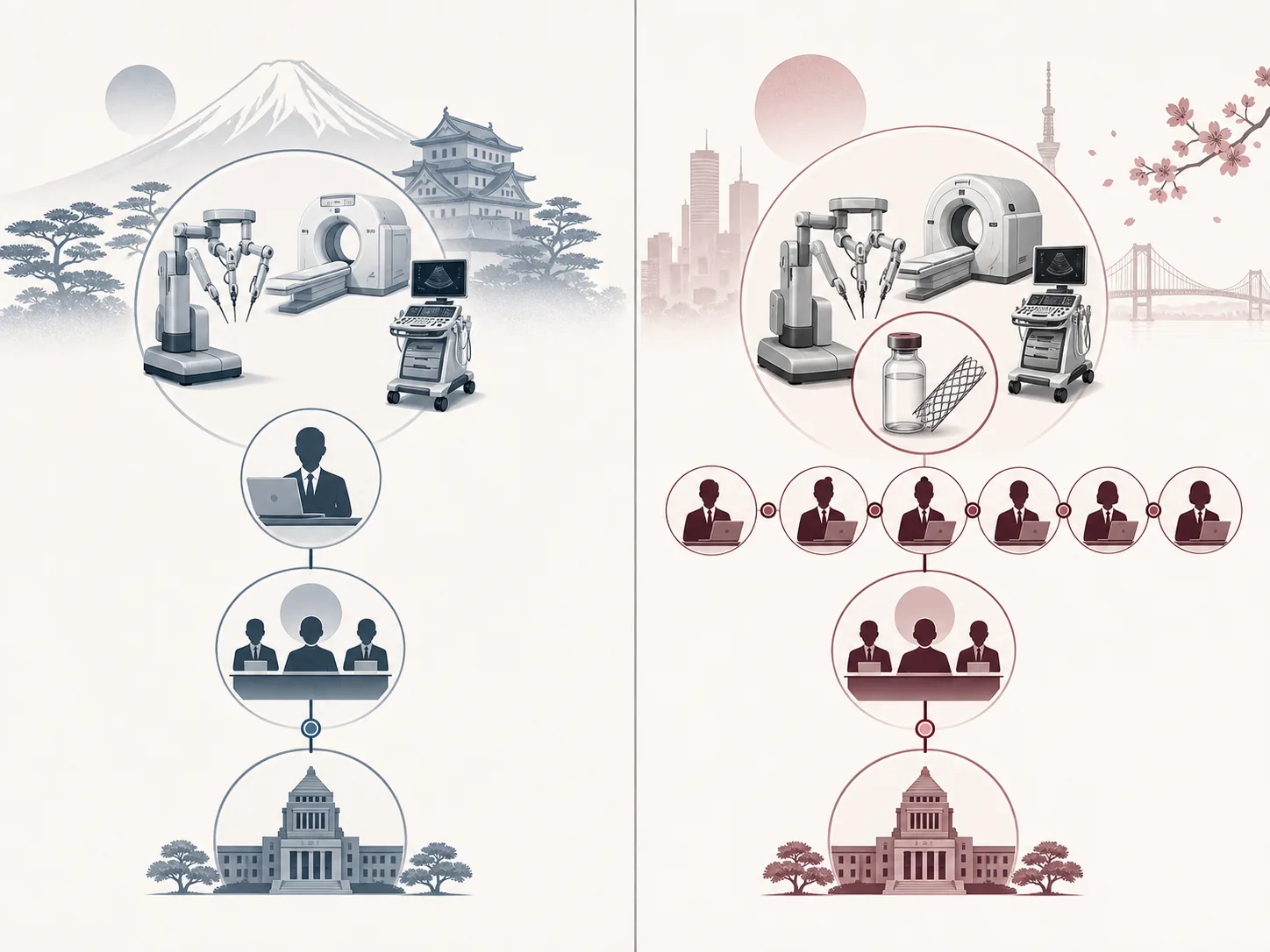
The split between A and B is not about how difficult or how new a procedure is. It is about whether unapproved products are involved.
| Advanced Medical Care A | Advanced Medical Care B | |
|---|---|---|
| Core criterion | Medical technology not involving the use of unapproved pharmaceuticals, medical devices or regenerative medical products, nor their off-label use | Medical technology involving the use of unapproved pharmaceuticals, medical devices or regenerative medical products, or their off-label use |
| Also included | Technologies involving unapproved in-vitro diagnostics where “the effect on the human body from carrying it out is extremely small” | Technologies which, in light of safety and efficacy, require “particularly intensive observation and evaluation” of the implementation environment and the effects of the technology |
| Practical consequence | Lighter oversight burden on the institution | Heavier oversight; a summary report is later evaluated |
Definitions above are quoted from the ministry’s explanatory material on the hoken-gai heiyō ryōyōhi framework; that document is dated 25 March 2016 and the wording is the standing regulatory formulation. As of July 2026 the breakdown was 28 technologies under A and 45 under B, together the 73 total cited above.
One consequence worth stating plainly: a Type B designation is not a warning label and a Type A designation is not a seal of approval. B simply means an unapproved or off-label product is in play, which is exactly why the observation requirements are heavier.
Who decides which is which
The sorting is done by the Advanced Medical Care Council, administered through the Health Insurance Bureau’s Medical Economics Division. Its agenda is a direct record of what it handles. At its 150th meeting, held on 8 January 2026, the items were: the allocation of newly accepted technologies to Type A or Type B, the scientific evaluation of advanced medical technologies, evaluation of summary reports on Type B technologies, and the meeting schedule for fiscal 2026.

So the categories are not static. Technologies enter, get sorted, get evaluated, and eventually leave — either into insurance coverage or out of the list.
How to look up a specific technology yourself
The ministry publishes three separate lists, and the distinction between them is the thing most people get wrong. If you are checking on a particular treatment, you will usually need more than one.
- Facility requirements list — the conditions an institution must satisfy to perform a given technology: kikan01
- List of institutions performing advanced medical care — which hospitals are actually doing it, by prefecture: kikan02
- Outline of each technology — the technology name, its indication, and a description: kikan03

A note on reading them: each list carries its own “as of” date, and the dates do not always match each other. Check the date printed on the page you are actually reading before relying on a figure from it. A treatment listed as available at an institution on one list may have changed status by the time another list is refreshed.
FAQ
Does “advanced medical care” mean the treatment is better than the insured option?
No. The designation means the treatment is under evaluation for whether it should become insurance-covered. It carries no claim about being superior to standard covered care.
How many technologies are currently designated?
73, as of August 2026. As of July 2026 this was 28 under Type A and 45 under Type B.
What is the actual difference between Type A and Type B?
Whether unapproved pharmaceuticals, medical devices or regenerative medical products are used, or used off-label. Type B involves them; Type A does not, with a narrow exception for certain unapproved in-vitro diagnostics whose effect on the body is extremely small.
Is the whole treatment paid out of pocket?
No. Under the hoken-gai heiyō ryōyōhi framework, portions common to general medical care — the ministry gives basic hospitalisation fees as its example — are covered by insurance, while the advanced medical care portion is the patient’s own burden.
Can a technology be removed from the list?
Yes. The Advanced Medical Care Council evaluates technologies and handles summary reports for Type B; technologies move into insurance coverage or off the list over time.
Related reading on Tsubaki Journal: carbon ion radiotherapy under this system, what “FDA approved” does and does not mean for Japan, and more in the Japan Frontier Technology archive.
References
- 厚生労働省「先進医療の概要について」https://www.mhlw.go.jp/stf/seisakunitsuite/bunya/kenkou_iryou/iryouhoken/sensiniryo/index.html
- 厚生労働省「保険外併用療養費制度について」(平成28年3月25日 薬事・食品衛生審議会薬事分科会資料)https://www.mhlw.go.jp/content/12400000/001471580.pdf
- 厚生労働省「第150回先進医療会議の開催について」(令和8年1月8日開催)https://www.mhlw.go.jp/stf/newpage_67092.html
- 厚生労働省「当該技術を実施可能とする医療機関の要件一覧」https://www.mhlw.go.jp/topics/bukyoku/isei/sensiniryo/kikan01.html
- 厚生労働省「先進医療を実施している医療機関の一覧」https://www.mhlw.go.jp/topics/bukyoku/isei/sensiniryo/kikan02.html
- 厚生労働省「先進医療の各技術の概要」https://www.mhlw.go.jp/topics/bukyoku/isei/sensiniryo/kikan03.html
出典:厚生労働省ホームページ(https://www.mhlw.go.jp/stf/seisakunitsuite/bunya/kenkou_iryou/iryouhoken/sensiniryo/index.html)を加工して作成。
This article is for information only. It is not medical advice, not guidance on any specific treatment, and not advertising for any prescription medicine. It does not recommend any medical institution. Facts here come from Ministry of Health, Labour and Welfare public materials; Tsubaki Trading holds a Tokyo Metropolitan Governor’s wholesale pharmaceutical distribution licence (No. 5313250689) and works with these regulatory documents directly. See our editorial policy.