


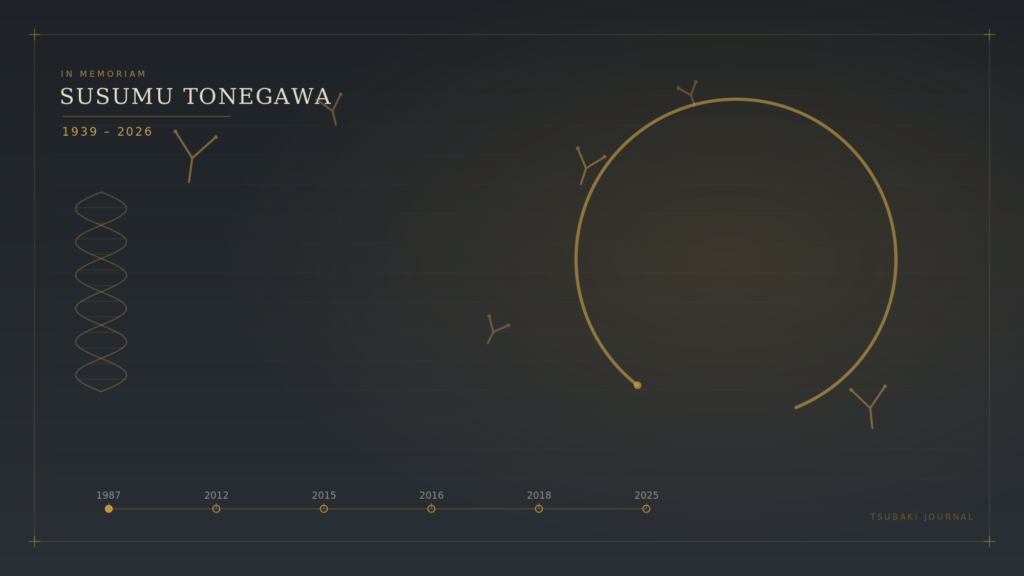
Susumu Tonegawa, the molecular biologist who in 1987 became the first Japanese scientist to receive the Nobel Prize in Physiology or Medicine, died on 11 July 2026 at the age of 86. The Massachusetts Institute of Technology, his academic home for more than four decades, announced his passing on 15 July. His discoveries reshaped immunology and, in a remarkable second career, our understanding of memory itself.
For a company built around Japanese medicine, his passing is an occasion to look back — not only on one extraordinary scientist, but on the line of Japanese laureates in the life sciences that he helped to begin.
A scientist of two disciplines
Tonegawa was born in Aichi Prefecture in 1939 and graduated from Kyoto University before moving to the United States to study molecular biology. It was at the Basel Institute for Immunology in Switzerland that he carried out the work for which he is best remembered.
In the early 1980s he answered one of immunology’s oldest questions: how the body can produce a seemingly limitless variety of antibodies from a limited set of genes. Tonegawa showed that immune cells physically rearrange segments of their own DNA, shuffling a modest genetic toolkit into millions of distinct antibodies. The discovery earned him the 1987 Nobel Prize, awarded to him alone, “for his discovery of the genetic principle for the generation of antibody diversity.”
He might have stopped there. Instead, he turned to neuroscience. As founding director of MIT’s Picower Institute for Learning and Memory and director of the RIKEN Brain Science Institute in Japan, he spent his later decades studying “engrams” — the physical traces that memories leave in the brain — becoming one of the few scientists to make landmark contributions in two entirely different fields.
Why his discovery still matters
Antibody diversity sits at the foundation of modern immunology. The principle Tonegawa uncovered underlies how scientists understand vaccination, autoimmune disease and the immune-based therapies developed in the decades since. It is textbook knowledge today precisely because he made it so.
Japan’s Nobel lineage in Physiology or Medicine
When Tonegawa accepted his prize in 1987, he was the first Japanese laureate in the medicine category. He would not be the last. Five more Japanese scientists have since joined him — a run that reflects the country’s sustained investment in patient, fundamental research:
- 1987 — Susumu Tonegawa: the genetic principle behind antibody diversity.
- 2012 — Shinya Yamanaka: induced pluripotent stem (iPS) cells, showing that mature cells can be reprogrammed to an embryonic-like state (shared with John B. Gurdon).
- 2015 — Satoshi Ōmura: discoveries leading to a novel therapy against roundworm parasites (shared with William C. Campbell; the other half of the prize went to Tu Youyou).
- 2016 — Yoshinori Ohsumi: the mechanisms of autophagy, the process by which cells recycle their own components.
- 2018 — Tasuku Honjo: cancer therapy by inhibition of negative immune regulation — the discovery of PD-1 that underpins immune-checkpoint therapy (shared with James P. Allison).
- 2025 — Shimon Sakaguchi: discoveries concerning peripheral immune tolerance and regulatory T cells (shared with Mary E. Brunkow and Fred Ramsdell).
One thread runs unmistakably through this list: immunology. Tonegawa in 1987, Honjo in 2018 and Sakaguchi in 2025 each illuminated a different facet of how the immune system defends the body — and how it learns not to attack itself. It is a field in which Japanese science has left a particularly deep mark.
Remembering a quiet pioneer
At Tsubaki Trading we work every day with the products of Japan’s health and pharmaceutical industries. The scientific culture that these laureates represent — rigorous, patient and endlessly curious — is inseparable from what “made in Japan” has come to mean in medicine. We join scientists and colleagues around the world in remembering Professor Tonegawa, and the standard he set. You can read more essays like this in the Tsubaki Journal.
This article is an informational and commemorative piece. Biographical and scientific details are drawn from public sources, including MIT News, The Japan Times and NobelPrize.org, and may be updated as further information becomes available. Nothing here constitutes medical advice or product promotion; the laureates’ discoveries are described for historical and educational context only.
Frequently asked questions
Who was Susumu Tonegawa?
A Japanese-born molecular biologist and MIT professor. In 1987 he became the first Japanese scientist to win the Nobel Prize in Physiology or Medicine, for explaining how the immune system generates antibody diversity. He later became a leading neuroscientist studying memory.
When did Susumu Tonegawa die?
He died on 11 July 2026 at the age of 86; MIT announced his death on 15 July 2026.
What did he win the Nobel Prize for?
“For his discovery of the genetic principle for the generation of antibody diversity” — the mechanism by which a limited number of genes can produce a vast range of antibodies.
How many Japanese scientists have won the Nobel Prize in Physiology or Medicine?
Six to date: Susumu Tonegawa (1987), Shinya Yamanaka (2012), Satoshi Ōmura (2015), Yoshinori Ohsumi (2016), Tasuku Honjo (2018) and Shimon Sakaguchi (2025).