


Medical information notice: This article is for informational reference only. It does not constitute diagnosis, treatment, medication, or advice on seeking medical care in Japan, and it cannot replace in-person consultation with a physician. For matters involving medicines, examinations, clinical trials, or regenerative-medicine indications, please rely on the latest public information from medical institutions and competent authorities, and seek assessment by a qualified physician.
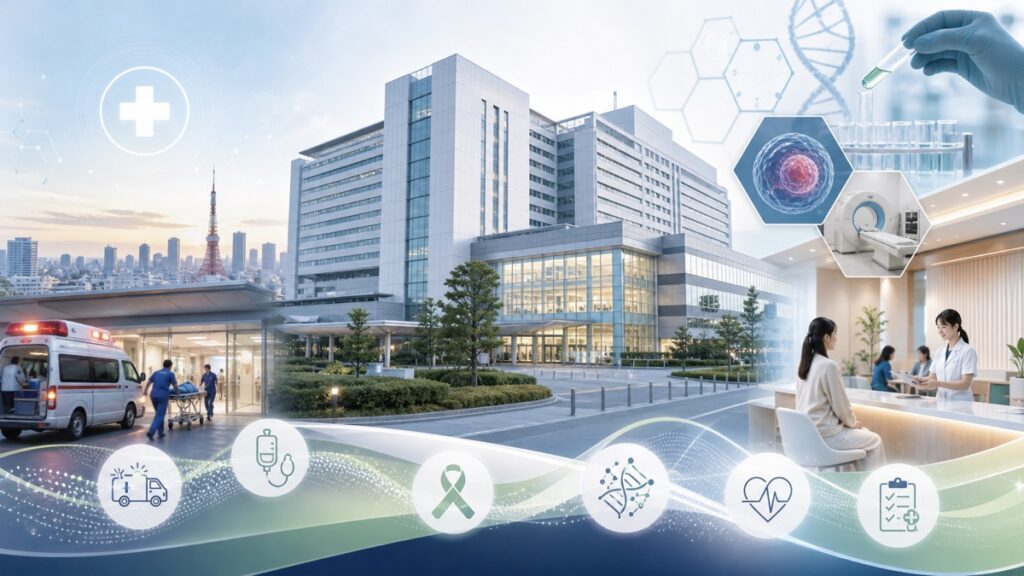
Information status: July 7, 2026. This article, based on the topic of the original WeChat article, has been reorganized together with official materials from Nippon Medical School Hospital, the Yaesu Health Check-up Station, and others. It does not constitute medical advice.
Nippon Medical School Hospital is located in Sendagi, Bunkyo-ku, Tokyo, and is one of Japan’s long-established university hospitals. For patients planning to seek medical care in Japan, judging whether a hospital suits them cannot be based only on “reputation”; one should look more at its position within the Japanese medical system, its specialty strengths, its capacity to handle emergencies and critical illness, and whether, once an abnormality is found, one can seamlessly enter the treatment process.
1. Why this hospital is worth noting
Official information from Nippon Medical School Hospital indicates that the hospital has undergone hospital-function evaluation by the Japan Council for Quality Health Care, and holds designations such as specified-function hospital, advanced critical care and emergency center, designated cancer-care collaboration base hospital, and Tokyo disaster base hospital. For international patients, this means it is not a single-specialty clinic but a large comprehensive hospital with the capacity for difficult and severe cases, multidisciplinary collaboration, and emergency support.
Such hospitals are especially suited to three kinds of needs: complex diseases that require a clear diagnosis or a second opinion; oncology, cardiovascular, or endocrine-surgery cases that require multi-department collaboration; and people who wish to enter subsequent specialty care through a high-end health checkup.
2. Respiratory surgery: lung cancer, mediastinal tumors, and airway intervention
The key points listed in the official introduction of Nippon Medical School Hospital’s respiratory surgery include da Vinci robotic surgery for lung cancer and mediastinal tumors, laser and stent treatment for central airway stenosis, multidisciplinary treatment for advanced lung cancer, and bronchoscopic treatment research targeting peripheral-type lung cancer.
This has practical significance for patients with early-stage lung cancer, recurrence, or those unable to tolerate traditional surgery. However, any “minimally invasive” or “no-incision” treatment must be judged based on imaging, pathology, staging, and overall physical condition, and a treatment plan cannot be decided on the strength of a technology’s name alone.
3. Gastrointestinal surgery: minimally invasive, robotic, and complex-case assessment
The original article mentions that the hospital’s gastrointestinal surgery covers areas such as the esophagus, stomach, large intestine, and hepatobiliary-pancreatic region, emphasizing laparoscopy, robot-assisted surgery, and complex-case assessment. For patients traveling to Japan, what truly needs attention is whether the hospital can strike a balance among curative intent, function preservation, and the patient’s overall tolerance.
For example, patients who are elderly, have concurrent heart and lung disease, or have been considered high surgical risk by other hospitals often need not just “whether it can be resected,” but a treatment path jointly assessed by surgical, anesthesia, imaging, internal-medicine, and nursing teams.
4. Cardiovascular medicine: a 24-hour emergency and critical-care system and structural heart disease treatment
The cardiovascular strengths of large university hospitals are usually reflected in two things: rapid handling of emergencies such as acute myocardial infarction, and long-term management of complex cardiovascular disease. The cardiovascular medicine department of Nippon Medical School Hospital is closely linked with its emergency system, intensive care, and catheter treatment, giving it comprehensive diagnostic and therapeutic significance for diseases such as ischemic heart disease, arrhythmia, valvular disease, and cardiomyopathy.
For international patients, if there are acute symptoms such as chest pain, heart failure, or severe arrhythmia, priority should be given to handling them at local emergency care, and one should not wait for cross-border medical arrangements.
5. Endocrine surgery: the thyroid and the need for cosmetic neck incisions
Nippon Medical School has long-term accumulation in endoscope-assisted thyroid surgery. The VANS method mentioned in the original article focuses on placing the incision in a relatively hidden location, minimizing visible neck scarring while meeting treatment requirements. For patients with benign or malignant thyroid disease, the choice of surgical approach needs to integrate the nature and size of the tumor, the status of the lymph nodes, prior surgical history, and the patient’s expectations regarding appearance.
6. Yaesu Health Check-up Station: from checkup packages to individualized risk assessment
The Nippon Medical School Yaesu Health Check-up Station is located on floors 6 and 7 of TOFROM YAESU TOWER, in front of Tokyo Station. Its official page shows that it offers examinations such as PET/CT, MRI, CT, endoscopy, and ultrasound, and emphasizes “preemptive preventive medicine” and individualized precision prevention. Unlike traditional fixed packages, the value of such a center lies in moving the research and specialty capabilities of a university hospital forward into the screening stage.
For overseas health-checkup populations, a more practical approach is: first clarify age, family history, past medical history, and tumor markers or imaging abnormalities, and then decide whether to choose combinations such as PET/CT, brain and cardiovascular screening, gastrointestinal endoscopy, and women’s specialized examinations.
7. What to prepare before seeking medical care in Japan
- Recent imaging DICOM data, pathology reports, a medication list, and treatment history.
- The problem you hope to address: a definitive diagnosis, a second opinion, surgical assessment, checkup screening, or post-treatment follow-up.
- A summary of the condition in Chinese and Japanese or in English, to avoid information being too scattered at the physician’s first consultation.
- Keep a distinction between “can be done” and “suitable to do”; advanced technology does not mean it applies to every patient.
Conclusion
The value of Nippon Medical School Hospital lies not in any single technology, but in the continuous network formed among the university hospital, the emergency and critical-care system, oncology care, cardiovascular treatment, and precision health checkups. For international patients, it is better suited as a candidate hospital for complex-condition assessment, specialty treatment, and the follow-on connection after a high-end health checkup.