


Information status: July 8, 2026. This article is compiled from publicly available materials from Japan’s National Cancer Center, the QST, the Cancer Information Service, and others. It is provided for medical-information reference only and cannot replace the judgment of your attending physician and radiation oncologist.
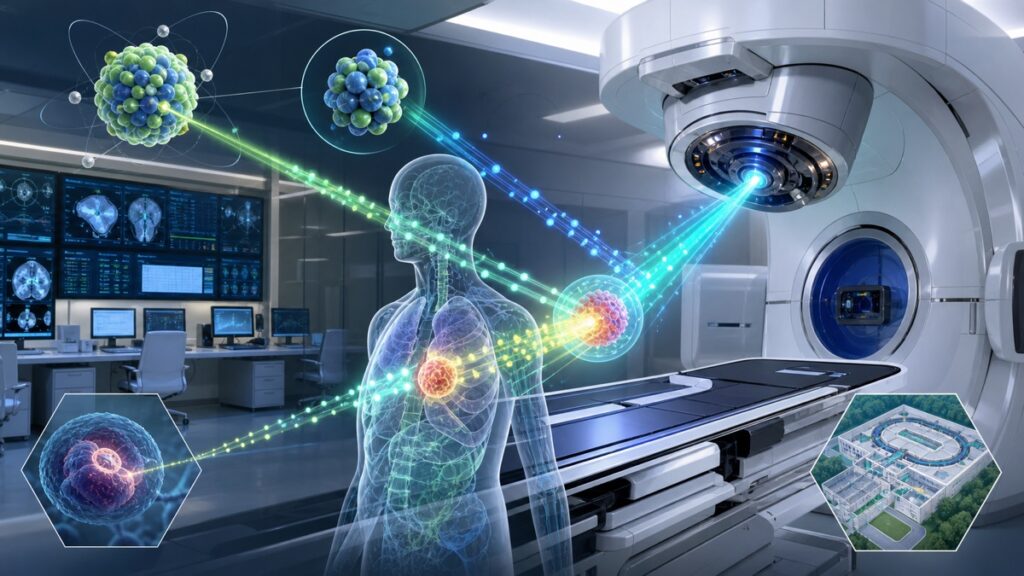
Advanced cancer treatments in Japan are often grouped together by Chinese-speaking users as “advanced radiotherapy,” but BNCT, proton-beam therapy, and heavy-ion (carbon-ion) therapy are not the same technology, nor is each one suitable for everyone. Before an actual consultation, understanding the logic of each will be more effective than simply asking “which hospital is the best.”
1. BNCT: combining a boron drug with neutron irradiation
The National Cancer Center explains that BNCT first has a boron-containing drug accumulate in tumor cells, and then applies neutron irradiation so that the reaction occurs mainly inside the lesion. In Japan, there are currently insurance-covered scenarios related to recurrent or locally advanced head and neck cancer, as well as clinical-trial directions such as solid tumors of the chest.
BNCT is not an upgraded version of ordinary radiotherapy, nor can it be used for every recurrent cancer. Whether it is suitable depends on the pathological type, prior radiotherapy dose, lesion location, general condition, assessment of drug accumulation, and whether the hospital is currently accepting the corresponding indication.
2. Proton beam: using dose-distribution advantages to protect surrounding tissue
Proton-beam therapy is a form of particle therapy that, by using physical properties such as the Bragg peak, can reduce irradiation of the surrounding normal tissue at certain tumor sites. It is often discussed for pediatric tumors, head and neck, prostate, and hepatobiliary-pancreatic sites, but whether it is actually superior to conventional radiotherapy must be judged case by case.
3. Heavy-ion therapy: high-LET particle treatment built up over the long term in Japan
The QST Hospital is an important center for heavy-ion therapy in Japan. Heavy-ion beams are characterized by concentrated dose distribution and relatively strong biological effects, and are often used for some intractable, deep-seated tumors, or tumors relatively insensitive to conventional radiotherapy. It likewise has distinctions among insurance-covered, advanced-medicine, and investigational indications.
4. What to prepare before consulting
- Confirmed pathology reports, immunohistochemistry, and genetic-testing results.
- Recent imaging such as CT, MRI, and PET-CT, along with DICOM data.
- Records of prior surgery, radiotherapy dose, chemotherapy, immunotherapy, and targeted therapy.
- Current physical status, main symptoms, comorbidities, and medications currently in use.
- Your attending physician’s opinion, and the purpose of the consultation you seek: cure, control, symptom relief, or a clinical trial.
For Tsubaki, the role of this kind of article is to help users first build an awareness of “indications and document preparation,” and then approach a medical institution for an inquiry, rather than simply packaging cutting-edge technology as a purchasable product.
References
- National Cancer Center Hospital: Hospital-Based BNCT
- QST: About Heavy-Ion Therapy
- QST Hospital: Medical Consultation for Overseas Patients
- Japan Cancer Information Service: Types and Methods of Radiotherapy
- Foundation for the Promotion of Medical Atomic Technology: Information on BNCT-Implementing Medical Institutions