


Medical information notice: This article is for informational reference only. It does not constitute diagnosis, treatment, medication, or advice on seeking medical care in Japan, and it cannot replace in-person consultation with a physician. For matters involving medicines, examinations, clinical trials, or regenerative-medicine indications, please rely on the latest public information from medical institutions and competent authorities, and seek assessment by a qualified physician.
Information status: July 7, 2026. This article is compiled from public materials of Heartseed/Nikon, jRCT, Cuorips, PMDA, and others. HS-005 is still in the clinical-trial stage and is not a routine treatment.
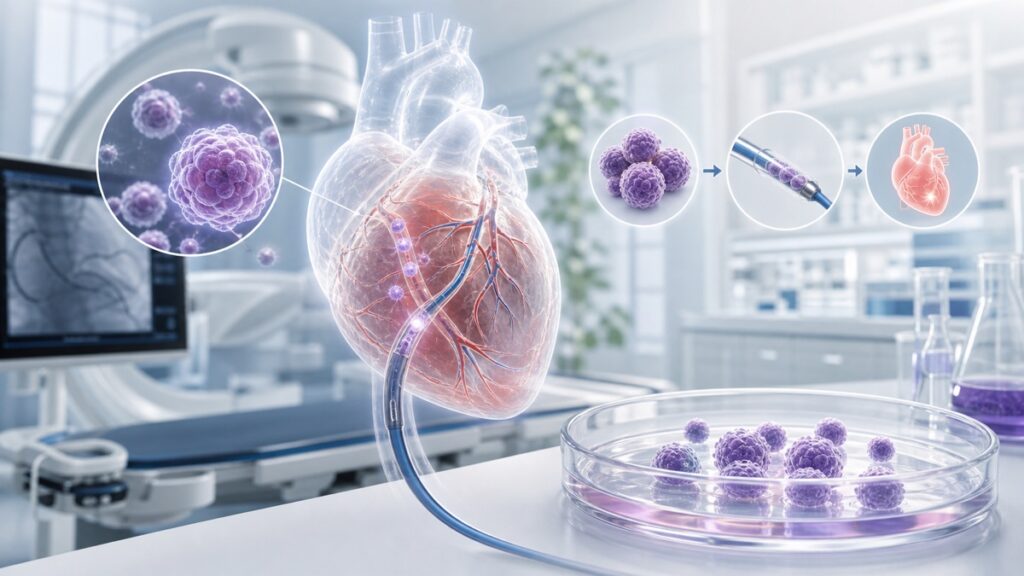
In June 2026, Heartseed announced that HS-005 had completed dosing of its first patient in the domestic Japanese Phase I/II EMERALD trial. This therapy uses allogeneic iPS-cell-derived cardiomyocyte spheroids, injected into the myocardium from inside the heart via a catheter, aiming to offer a more minimally invasive path of myocardial regenerative treatment for patients with severe heart failure with reduced ejection fraction.
1. Why heart failure needs regenerative medicine
Heart failure is a progressive disease in which the heart cannot pump blood effectively. Global research reviews estimate that heart failure affects more than 64 million people. Existing treatments can improve symptoms, slow progression, and reduce the risk of hospitalization and death, but for some end-stage patients, treatments that can truly replace damaged myocardium remain very limited.
Heart transplantation is limited by donor availability, and mechanical assist devices are not suitable for every patient. As a result, using cell therapy to repair or supplement damaged myocardium has become an important direction in Japanese regenerative medicine.
2. What HS-005 did
According to Nikon’s official news, HS-005 is a cardiomyocyte-spheroid preparation formed from high-purity ventricular muscle cells derived from iPS cells, administered on the endocardial side via a catheter system. Unlike the open-chest approach that injects from the outer side of the heart, the catheter approach aims to reduce trauma, making the treatment more suitable for elderly people or those at higher surgical risk.
The first patient was a person with severe heart failure caused by dilated cardiomyopathy, who completed dosing in late March 2026 at Shinshu University School of Medicine Hospital. Public materials indicate that the post-procedure course was generally smooth, the patient has been discharged, and an independent safety evaluation committee, based on four-week data, agreed to continue the trial in the dilated-cardiomyopathy group.
3. The differences among HS-001, HS-005, and ReHeart
Several different paths have currently emerged in Japanese cardiac regenerative medicine:
- HS-001: Heartseed’s open-chest injection route, injecting cardiomyocyte spheroids into the myocardium from the outer side of the heart.
- HS-005: Heartseed’s catheter-delivery route, performing intramyocardial injection from inside the heart, with the goal of low invasiveness.
- ReHeart: an iPS-cell-derived cardiomyocyte sheet developed by Cuorips, which received conditional and time-limited approval in Japan in March 2026, primarily targeting severe heart failure associated with ischemic cardiomyopathy.
All three relate to iPS-cell-derived cardiomyocytes, but they differ in product form, method of administration, scope of indication, and regulatory stage, and should not be conflated.
4. Why catheter delivery matters
Open-chest surgery lets physicians see the surface of the heart directly, but it is more invasive. If catheter delivery can be shown to be safe and effective, there is an opportunity to reduce the physical burden, shorten recovery time, and expand the range of patients who can be considered for regenerative-medicine assessment.
However, the catheter approach also has challenges: how to precisely locate the injection point, how to confirm that cells enter the correct myocardial layer, and how to avoid risks such as arrhythmia, perforation, or embolism are all questions that clinical trials must answer.
5. What ReHeart’s approval means
According to Cuorips’s official information, its iPS-cell-derived cardiomyocyte therapy product ReHeart received conditional and time-limited approval in Japan in March 2026. This is an important milestone in iPS cardiac regenerative medicine moving from research toward regulatory approval.
However, “conditional and time-limited approval” does not mean that all efficacy verification has been completed. Japan’s regenerative-medicine regulation allows earlier entry into clinical use under certain conditions, while requiring continued collection of safety and efficacy data after marketing.
6. How patients should understand these developments
For patients with severe heart failure, iPS cardiac regenerative medicine is a frontier direction worth watching, but at this stage it is still necessary to strictly distinguish among approved products, clinical-trial products, and research concepts. Whether it is suitable depends on the cause of heart failure, ejection fraction, arrhythmia risk, prior surgical history, comorbidities, response to drug therapy, and clinical-trial conditions.
International patients interested in this kind of treatment should first prepare echocardiography, MRI/CT, coronary examination, prior surgical records, a medication list, and recent hospitalization materials, and be assessed by a heart-failure specialist.
Conclusion
The completion of HS-005’s first catheter delivery shows that Japan’s iPS cardiac regenerative medicine is moving from “whether cells can be produced” toward “how to deliver them to the heart more safely and less invasively.” This step is important, but it remains in the clinical-trial stage that requires careful verification.