


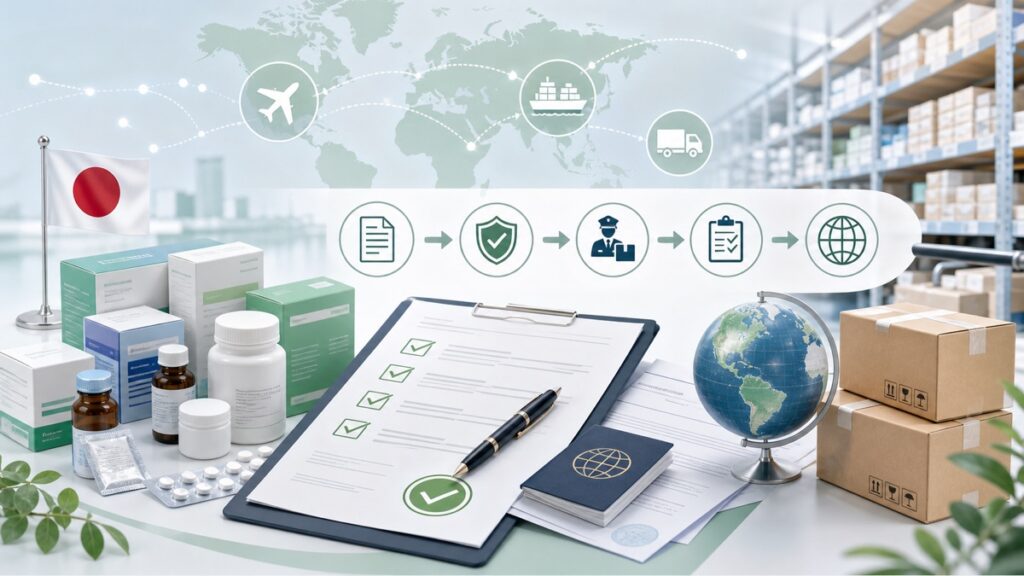
Japan is one of the world’s most respected sources of pharmaceuticals and health products — and one of the most tightly regulated. For international buyers, understanding how Japan classifies and controls these products is the first step to a smooth, compliant import. This overview explains the legal framework, the main product categories and what to prepare.
The law: the PMD Act
The core legislation is the Pharmaceuticals and Medical Devices Act (PMD Act) — formerly the Pharmaceutical Affairs Law. It governs the research, development, manufacturing, import and distribution of pharmaceuticals, quasi-drugs, cosmetics and medical devices. Two bodies administer it: the Ministry of Health, Labour and Welfare (MHLW), which sets policy, and the Pharmaceuticals and Medical Devices Agency (PMDA), which reviews applications scientifically and monitors post-marketing safety.
Product categories you will encounter
- Prescription drugs (医療用医薬品) — dispensed under a physician’s prescription; the most strictly controlled.
- OTC medicines (一般用医薬品) — sold in pharmacies without prescription, graded by risk class.
- Quasi-drugs (医薬部外品) — products with MHLW-approved active ingredients for defined, mild effects, sitting between cosmetics and drugs.
- Health foods and supplements (健康食品) — including regulated categories such as Foods with Function Claims; not classified as drugs.
Each category carries different labelling, claim and documentation rules. A product’s category in Japan does not automatically match how it will be classified in the destination country — a common source of import friction.
Export and manufacturing standards
Japanese manufacturers operate under Good Manufacturing Practice (GMP) requirements. Where a foreign government or organization requires it, a manufacturer can be certified by MHLW that its manufacturing and quality-control methods conform to Japan’s GMP Ministerial Ordinance, with re-certification typically every five years. This documentation often supports registration in the buyer’s market.
What international buyers should prepare
Before ordering, buyers should confirm: the product’s Japanese category and its classification in the destination country; required import licences or notifications locally; whether certificates such as GMP, Certificate of Pharmaceutical Product (CPP) or free-sale certificates are needed; and labelling/language requirements. Partnering with a Japan-based trading company streamlines sourcing, authenticity checks and paperwork. Tell us your target market and product list through our inquiry form and we will advise on what is feasible.
Frequently asked questions
What law regulates pharmaceuticals in Japan?
The PMD Act (formerly the Pharmaceutical Affairs Law).
What is a quasi-drug?
A product with MHLW-approved active ingredients for defined, mild effects — between cosmetics and pharmaceuticals.
Who oversees drug safety?
MHLW sets policy; PMDA reviews applications and monitors safety.
This article is general institutional information about Japan’s regulatory framework and is not legal advice. Import rules vary by destination country; confirm requirements with the relevant authority for your market.